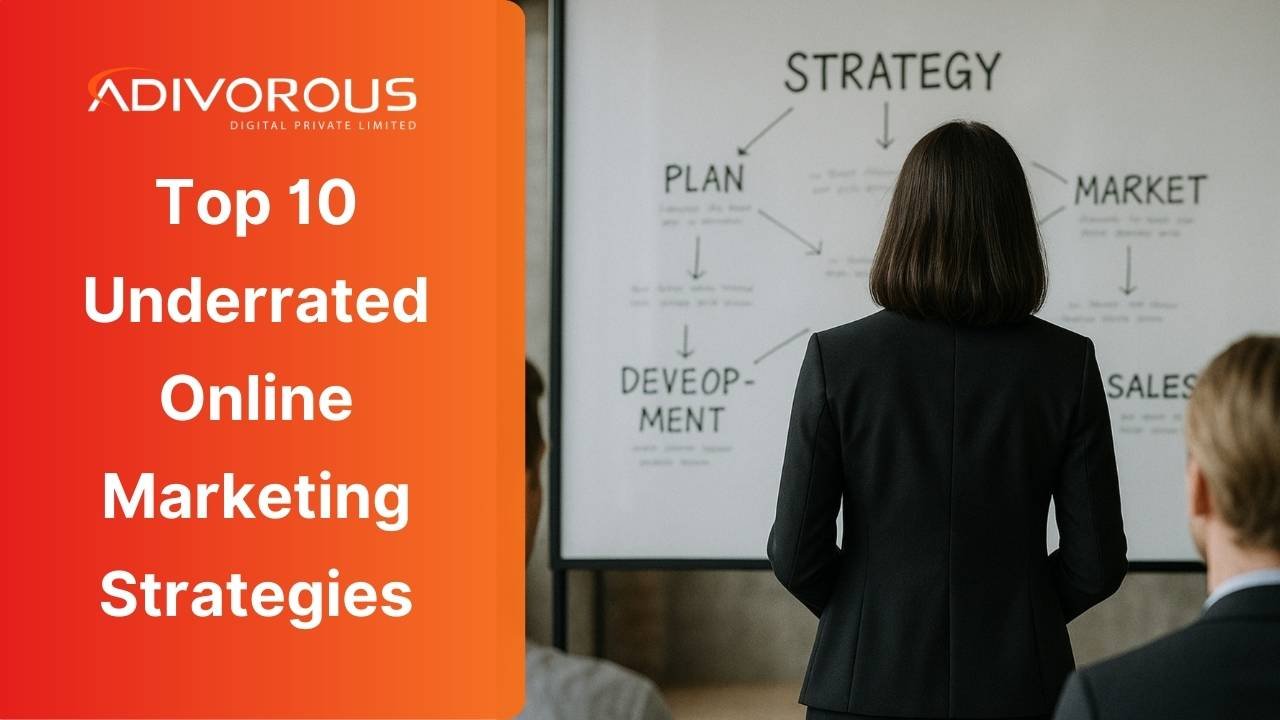
Even though online marketing is now mature, many marketers still miss the basic practices to run behind flashy strategies. In an era dominated by high-cost PPC (Pay-Per-Click) ads and saturated social media feeds, the most successful brands are those that take advantage of every available strategy, while others chase the moon. As AI shifts from a “novelty” to a “standard,” the real opportunities for growth lie in strategies that most marketers overlook because they require more creativity than capital. Here are the top 10 underrated online marketing strategies by Adivorous to give your brand a competitive edge.
1. Generative Engine Optimization is the Next Step of Online Marketing
Internet marketers who are still locked in the battle for Google Search’s ranking page ranking spot are missing the bigger picture. The real competition now lies in AI-powered search ecosystems. Platforms like Gemini, ChatGPT, and Perplexity don’t just list links, but they deliver synthesised, conversational answers that shape user decisions instantly. This means the rules of visibility are changing:
- Content must be structured for AI comprehension, not just keyword density.
- Authority and clarity matter more than backlinks, because AI models prioritise trustworthy, well-explained sources.
- Brand voice needs to be adaptable, since AI often paraphrases or condenses messaging into its own narrative.
In short, the future of search isn’t about ranking; it’s about being the source AI trusts enough to cite and summarise. The AI needs to trust that your content is factually correct enough to be cited. Savvy marketers are already optimising for this shift, ensuring their content is not only discoverable but also AI-ready. Therefore, you don’t need to stray further from the principles of SEO; create valuable content on the internet.
2. Become More Personal with Your Customer Community
In today’s landscape, mass reach is losing its edge. The chase for a million Instagram followers is giving way to something far more powerful: deep resonance with your followers. But now, brands are realising that influence doesn’t always happen in public, but it thrives in “personal social” spaces like WhatsApp groups, Telegram Channels, Discord servers, and gated Slack communities.
Therefore, to foster such an environment, create a members-only environment where your most loyal customers can be. Where they can connect, share experiences, and build relationships, not just with your brand, but with each other. For example, look at One Plus in 2014 or currently Nothing Phone brand that fosters community trust.
Unlike public feeds, these private circles don’t offer easy vanity metrics like “Likes” or “Shares.” But what they lack in visibility, they make up for in conversion power. In fact, engagement inside high-trust communities often delivers 5x–10x stronger results than traditional social platforms. This is the next frontier of digital marketing: less broadcasting, more belonging. The brands that win won’t be those shouting the loudest, but those cultivating spaces where customers feel seen, valued, and connected.
3. Connect Your Online Marketing with Real Life Connections
In an era where email inboxes are overflowing, the physical mailbox has become a quiet, overlooked channel. That emptiness is an opportunity for robust online marketing. Deploy programmatic direct mail when a high-value customer abandons their cart or lingers on your site without purchasing, automatically trigger a personalised postcard or letter to arrive at their doorstep. It’s the digital retargeting playbook, translated into the physical world.
Even though this strategy can be quite expensive, unlike email, this approach is actually more premium, tangible, and personal. It cuts through the digital clutter with a nearly 100% “open” rate. Because people don’t ignore their physical mail. And while it is harder to measure than clicks or likes, the impact is undeniable: direct mail in high-value segments often drives conversion lifts that digital alone can’t match.
Remember, this is the future of hybrid marketing where automated personalisation meets physical presence. Brands that embrace it will stand out not by shouting louder online, but by showing up offline in ways customers don’t expect. Bringing the internet and personal is the way forward.
4. Zero-Click Content Strategy for Online Marketing
Social platforms have made one thing clear, and that is they don’t want users leaving. Algorithms now aggressively suppress posts that push traffic to external sites, punishing marketers who rely on outbound links. Therefore, as a marketer, you need to simply flip the script by delivering 100% of the value inside the post itself. Use LinkedIn carousels or long-form X threads to unpack a concept fully, giving readers the complete takeaway without forcing a click. If you must share a link, tuck it into the comments or a secondary follow-up post.
Many marketers hesitate, worried about losing “site traffic.” But the truth is native-first content earns massive boosts in reach, engagement, and brand recall. So, the trade-off is worth it, as a few fewer distracted clicks in exchange for 10x more visibility and lasting audience trust. This is the new content game in this era: don’t fight the algorithm, but feed it. The brands that thrive will be those that stop treating social as a funnel and start treating it as a stage.
5. Capitalise on First-Party Data For Improved Online Marketing
With the disappearance of third-party cookies looming on the horizon, the era of “borrowed data” is about to be over. Therefore, marketers can no longer rely on external trackers to understand user behaviour. So, start building interactive “Data Magnets.” Think quizzes, ROI calculators, or AI-powered self-assessment tools that require a login. Each interaction becomes a moment of voluntary, consented data capture, forming a “Data Spine”. Which is a proprietary record of verified user intent that belongs entirely to your brand.
Yes, it’s more effort than spinning up another ad campaign. But the payoff is enormous. Instead of renting insights from third parties, you’re creating a unique, defensible asset that competitors can’t buy or replicate. Over time, this spine of first-party data becomes the foundation for personalised experiences, smarter targeting, and higher lifetime value. Remember, this is the new data economy where you don’t chase clicks but build consent. The brands that thrive will be those that invest in tools that customers actually want to use, turning engagement into intelligence.
6. Make Your Brand More Real in an AI World
Corporate logos may symbolise a brand, but they don’t carry a personality, but on the other hand, people do. And in a world saturated with AI-generated content, human authenticity has become a premium currency. Therefore, try to encourage leadership to share the “messy middle” part of their journey. For instance, the prototypes that didn’t work, the failures that taught lessons, and the behind-the-scenes decision-making that shaped the final product. Platforms like LinkedIn and YouTube are perfect stages for this kind of storytelling.
Keep in mind, traditional marketing teams often shy away from anything that feels “unpolished.” But today, unpolished is exactly what builds trust. Audiences crave transparency, vulnerability, and the human side of business. By documenting the journey, not just the polished outcome, brands create deeper resonance and stronger loyalty. The shift is from perfection to presence. The winning companies will be led by authentic leaders who connect with customers by navigating uncertainties together.
7. SEO Not Only for SERPs But for Socials
For Gen Z and Gen Alpha, Google isn’t the default search bar anymore (Something we showcased earlier). They’re turning to social platforms like Snapchat, Instagram, YouTube, and X as their primary search engines, especially for “how-to” guides, product reviews, and best-of lists. So, treat social posts like searchable assets. Optimise captions with search-friendly keywords, not just hashtags. Write in natural, conversational language so transcripts, subtitles, and alt-text can be indexed by the algorithm. This way, your content surfaces when users type queries directly into social search bars.
Unfortunately, Many marketers still see social media as a discovery tool, a place to stumble upon content. But for younger audiences, it’s already a search-first environment. By adapting your content for this shift, you’re not just chasing likes, but you’re positioning your brand to be the answer when someone searches inside Shorts or Instagram. After all, social isn’t just where people scroll, it’s where they search. The brands that recognise this early will own the queries that matter most to the next generation of buyers.
8. Understand Programmatic Creative Optimization (PCO)
In the online marketing of today, traditional A/B testing feels glacial. Waiting weeks to compare two ad variations is simply too slow for today’s hyper-dynamic digital environment. Therefore, you need to harness AI to generate hundreds of micro-variations. Each will have different backgrounds, hooks, CTAs, and formats, then let the algorithm auto-optimise in real time. Budgets shift instantly toward the winning creative, ensuring you’re always running the highest-performing ad without human lag.
Furthermore, this approach demands a hybrid mindset. Humans set the brand guardrails that include the tone, values, and compliance, while AI handles the rapid-fire iteration. Many teams resist because it feels like “giving up control.” But in reality, it’s about scaling creativity while protecting brand integrity. The payoff is enormous because you can learn faster while lowering the wasted spend. Moreover, the campaigns can evolve at the speed of culture. Thus, don’t wait for answers; let AI find them in real time. The brands that embrace this shift will outpace competitors still stuck in the slow lane of A/B testing.
9. Apply Intent-Based Audio Online Marketing
As ambient computing rises through smart glasses, wearables, and always-on assistants. Which indicates that audio-first content is emerging as the silent giant. While most marketers still obsess over visuals, the real opportunity lies in the medium you can’t see but can’t ignore. Because audio is invisible, it often gets overlooked. Yet it’s the only medium that commands 100% of a user’s attention while they’re away from a screen. Whether commuting, cooking, or working out. In a world where visual feeds are saturated, audio cuts through with intimacy, focus, and trust.
Thus, create “Audio-Shorts” that are tight, 60-second clips packed with value, designed to be easily surfaced by voice assistants. Pair this with host-read sponsorships on niche podcasts, which feel authentic and conversational compared to pre-produced ads. Together, these formats embed your brand directly into the daily rhythms of your audience. This is the next wave of marketing that speaks, not just shows. The brands that embrace audio-first strategies will own the moments when customers are most present, even if their eyes are elsewhere.
10. Hyper-Local Digital Geofencing and AI-Agent “Predisposition”
Mass targeting is expensive and wasteful. Therefore, for an effective online marketing strategy, use real-time “intent signals” to trigger mobile ads. Especially when a potential customer is within 500 meters of a competitor’s location or a relevant event. However, it is an underrated strategy because it’s seen as “retail only.” But B2B brands can use this at trade shows to “hijack” the attention of every attendee.
On the other hand, for the last couple of years, consumers have been using their own AI agents (shopping assistants) to find products. Unfortunately, most marketers only focus on “persuading the human,” forgetting that an AI agent might be the one making the initial “shortlist” for the buyer. You must market to the machine as much as to the human. This means providing highly structured, technical data sheets that an AI agent can easily digest to compare your product against others.
| Strategy | Effort | Primary Online Channel | 2026 Trend Alignment |
| GEO | High | AI Search / LLMs | Generative Search |
| Zero-Click | Low | LinkedIn / Threads | Algorithm Retention |
| Dark Social | High | Discord / Slack | Privacy & Trust |
| Social SEO | Medium | TikTok / Instagram | Intent Discovery |
Conclusion
The most effective online marketing strategies share one common thread: Intent over Keywords. Whether you are optimising for a human on Reels or an AI agent in a search bar, the winner is the brand that provides the most direct, authoritative value with the least friction. Remember, keywords may open the door, but intent determines whether the visitor steps inside.
FAQs
- What is the main difference between SEO and GEO?
- Traditional SEO aims to rank your website in a list of search results. Generative Engine Optimization (GEO) focuses on getting AI models (like Gemini or ChatGPT) to cite your brand as the primary source in their synthesised answers.
- Why use “Zero-Click” content if it doesn’t drive site traffic?
- Social algorithms suppress posts with external links to keep users on-platform. By providing the full value in the post, you gain massive organic reach and brand authority that eventually leads to higher-quality, direct searches for your business.
- How do I measure “Dark Social” if there are no tracking links?
- Since private shares in WhatsApp or Slack don’t show up in analytics, the best method is self-attribution. Add a “How did you hear about us?” field to your checkout or lead forms to capture the “word-of-mouth” traffic that software misses.
- How do I “convince” an AI Agent to recommend my product?
- AI agents prioritise structured data over storytelling. To be recommended, your site must feature clear pricing, technical specs, and comparison tables formatted with Schema markup so the AI can easily parse and verify your facts.